 Keynote
Keynote
Prof. Dr. Mennatallah El-Assady:
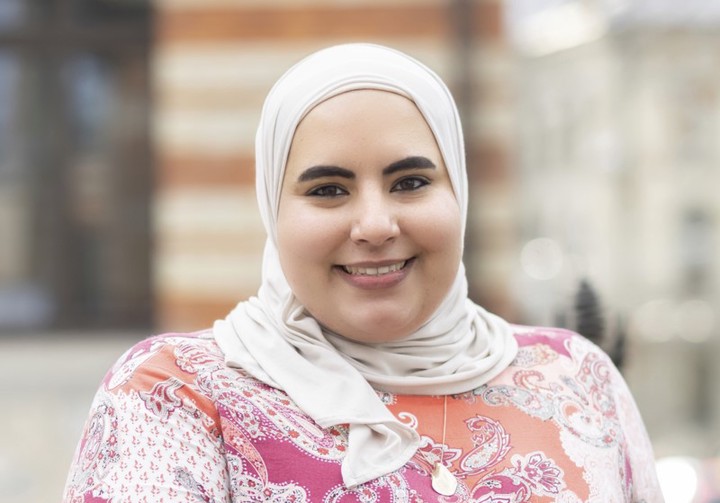
Prof. Dr. Mennatallah El-Assady:
Dr Mennatallah El-Assady is an Assistant Professor in the Department of Computer Science at ETH Zürich, where she leads the Interactive Visualization and Intelligence Augmentation (IVIA) lab. Prior to her current role, she was a postdoctoral research fellow at the ETH AI Center and held research associate positions in Germany and Canada. Her doctoral research on human-AI collaboration earned the prestigious joint dissertation award of the German, Austrian, and Swiss Informatics Societies, along with an honorable mention for the VGTC VIS Doctoral Dissertation Award.
El-Assady’s interdisciplinary work spans data analysis, visualization, computational linguistics, and explainable artificial intelligence, with a focus on designing interactive human-AI collaboration interfaces to enhance problem-solving and decision-making. Her work is driven by a passion for empowering individuals through co-adaptive processes between humans and AI agents.
With extensive experience collaborating with political science and linguistics scholars, El-Assady led the creation of the LingVis.io platform and is currently developing the novel human-AI.io communication framework. She is also a co-founder and co-organizer of several influential workshop series, including Vis4DH and VISxAI.
In recognition of her pioneering contributions, El-Assady was named a Eurographics Junior Fellow in 2023. Her groundbreaking work at the intersection of visualization and machine learning has also earned her the 2024 VGTC Significant New Researcher Award and the 2023 EuroVis Early Career Award.
Title:
Intelligence Augmentation: Bridging Human and Artificial Intelligence
Abstract:
Intelligence augmentation through mixed-initiative systems promises to combine AI’s efficiency with humans’ effectiveness. Central to this vision are co-adaptive visual interfaces, which facilitate seamless collaboration between humans and machines. In this talk, I will explore the importance of human-AI collaboration in decision-making and problem-solving, highlighting how tailored visual interfaces can enhance interaction with machine-learning models. These interfaces promote the understanding, diagnosis, and refinement of models. I will present various workflow designs for computational linguistics analysis and discuss emerging methods for integrating diverse human feedback. The talk will conclude with insights into the challenges we face today and the promising research directions that lie ahead.
Dr Narges Mahyar:
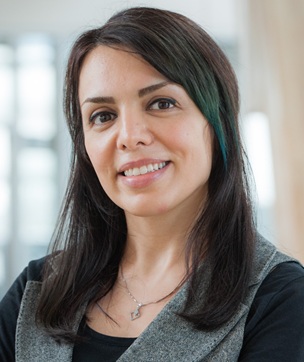
Dr Narges Mahyar:
Dr Narges Mahyar is a Senior Lecturer in the Department of Computer Science at City St George’s, University of London, and a 2024–2025 Radcliffe Fellow at Harvard University. Previously, she was an Associate Professor at the Manning College of Information and Computer Sciences at the University of Massachusetts Amherst. Her research lies at the intersection of visualization, human–computer interaction, social computing, and design, with a central focus on visualization for collective empowerment. She designs and studies human-centered AI and visualization systems that enable both experts and communities to reason together, navigate uncertainty, and make informed decisions in complex sociotechnical settings. Over the past decade, her work has advanced the field of Digital Civics, developing community-centered technologies that scale public participation in high-stakes domains such as climate risk, urban planning, and civic decision-making. Her research has been recognized with nine Best Paper and Honorable Mention awards at leading HCI and visualization venues. Narges holds a Ph.D. in Computer Science from the University of Victoria and completed postdoctoral research at the University of British Columbia and the University of California, San Diego.
Abstract:
Coming soon.